Estimated reading time: 9 minutes
Key Takeaways
- Liu Cixin‘s The Dark Forest follows humanity’s struggle against an alien invasion in a thought-provoking narrative.
- The Wallfacer program represents humanity’s defense strategy, with four selected individuals developing plans within their minds.
- Luo Ji, a mysterious Wallfacer, could hold the key to humanity’s salvation despite appearing to lack a plan.
- The Dark Forest theory addresses the Fermi Paradox, suggesting intelligent life remains silent to avoid destruction.
- Overall, The Dark Forest excels in a thrilling story filled with scientific discourse and moral ambiguity.
Short Summary
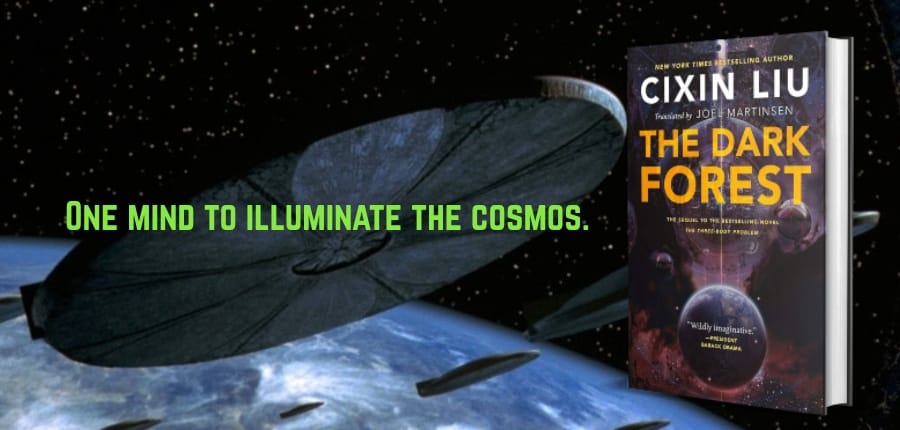
Liu Cixin, I believe, has established himself as one of today’s greatest Science-fiction writers, in the future, he will rightfully join the pantheon of the all-time masters of the genre. In The Dark Forest, the second book in the Remembrance of Earth’s Past trilogy, he continues the story of humanity’s preparation in the face of an alien invasion, this time focusing on “Wallfacers”. These are people tasked with developing defence strategies within the confines of their minds, and with unlimited resources to accomplish their goals.
Table of contents
Liu Cixin Continues the Saga of Humanity’s Doom
At this moment, we are living with the idea that we might very well be the sole intelligent living beings in the observable universe. So long as the question stands, we allow ourselves virtually anything, exposing our position in the universe and inviting anyone and anything to find us. However, should we one day discover that we do indeed have cosmic neighbours somewhere out there, the entire fabric of our existence will undeniably change, as it did for humanity in Liu Cixin‘s The Dark Forest, the second book in the Remembrance of Earth’s Past trilogy.
If you’ve yet to read the first book, The Three-Body Problem, I highly encourage you to do so before proceeding. Though the events may be taking place over a four-hundred-year period (for the most part), the trilogy was intended to be read as a single cohesive story, and I don’t think this is the kind of saga you can jump right in the middle of.
With this being said, I will assume that those who read onward have acquainted themselves with the first chapter already. This second one begins not too long after the end of the first book, with humanity struggling to come up with a plan to defend itself against the incoming Trisolaran fleet, about four hundred years away. Not only is humanity’s time limited, it also finds itself severely hampered by “Sophons”, tiny supercomputers which both spy on humanity and hamper its scientific progress.
In the face of this omnipresent and unavoidable threat, the United Nations come up with an idea: the “Wallfacer” program. The idea behind it is simple: four individuals are chosen to come up with plans of Earth’s defence entirely within the confines of their own minds, the one place Sophons cannot penetrate. They are given unlimited resources to achieve their plans, the only caveat is that in their execution, the Wallfacers must take care in hiding the true purpose of all their moves.
Three of the four people appointed for this job all have considerable political, scientific and military expertise, and they all quickly set to work in formulating their grand strategies. The fourth person begrudgingly appointed to the role is Luo Ji, a sociologist and ex-astronomer with no special qualifications save one: he is the sole person who was ever directly targeted for assassination by Trisolaris. Nobody knows why, not even Luo Ji himself, but the secret as what makes him so dangerous may yet be the key to humanity’s salvation.
The Enigma of the Wallfacers in The Dark Forest
From the get-go, I think it’s obvious that Liu Cixin likes to push his thinking to the next level, forcing the humanity in his imagination to contend with the sorts of threats the vast majority of us wouldn’t even dream of. The very premise of The Dark Forest is a very strong factor in hooking you in, prompting the reader to try and think how they would try to best the type of enemy which not only halted our collective scientific advancement, but is also spying on us twenty-four-seven.
In turn, the solution which humanity comes up with, the Wallfacer program, feels like nothing short of a genius move, almost beginning to tip the scales back in our favour. Each of the Wallfacers is given a good amount of attention, even if, as readers, we know that in the end Luo Ji is the important one. Ultimately, I felt as if they were presented as enigmas for us to solve.
Though perhaps their nominations might seem questionable at first-glance, all the Wallfacers prove themselves in short order, making grand an inexplicable demands, just as their roles dictate. Though none know what they are up to, they are showing the world that they are indeed up to something, that they have solutions and are working on them. All of them… except Luo Ji.
Though for the other three Wallfacers we can more or less infer at least in which directions their plans might go, Luo Ji stands as the greatest mystery of all, with the reason behind his appointment being unknown to him most of all. As a matter of fact, for a good part of the book it almost feels as if he’s wasting everyone’s money and trying their patience, using his unlimited resources to build an idyllic life for himself away from everyone else… which to be fair, doesn’t sound like the worst plan.
Adding to the excitement is the fact that the Wallfacer aren’t exactly working unimpeded. Human agents working for Trisolaris seem to have wormed their way into all spheres of society, and they are hard at work to expose the Wallfacers secret plans, rendering them obsolete; they call themselves the Wallbreakers.
The race between the execution of the plans and their unveiling is a thrilling one to watch, especially when things begin to go South for humanity, and the hopes for humanity’s salvation are increasingly transferred to Luo Ji’s shoulders, who himself doesn’t seem to have any plan at all… or does he? As far as the Wallfacers go, he is certainly the most cryptic and an extremely interesting protagonist to follow. Even though it’s a sci-fi novel, one has the impression it moves at the rhythm of an action story.
The Theory of Galactic Civilizations
Though I’m sure many of you think the opposite, but the Dark Forest theory actually derived its name from this very novel. While earlier works did appears with similar ideas, it was Liu Cixin‘s description of the theory which ultimately stuck with everyone. In short, it is an answer to the Fermi Paradox, stating that the universe is indeed filled with intelligent life, but everyone is keeping still and silent, afraid of inviting destruction from someone more advanced than them.
In such a world, any species has two possible course of evolution: either it screams early on and dies at the hands of someone much more advanced, or it grows intelligent enough to stop broadcasting evidence of its existence, and goes dark. The Dark Forest might very well be a hard science-fiction novel, the depth to which Liu Cixin dives into this idea is certainly something to behold.
He tries to adopt a galactically-objective perspective, at least much as such a thing is possible for a human being. He explores the idea from a logical perspective, the kind of logic we might assume will apply to the majority of living beings, should they exist. It would probably take me a whole novel to truly unravel the ideas he presented here, but in the end, I’ll just say he makes a rather compelling case that this model may have stronger legs to stand on than most people realize.
What really helps to sell the author’s meditations on the nature of our existence in the cosmos, is the fact that he obviously has a very strong grasp on mathematics and physics, which he often refers to in order to help cement his arguments. Though he does go quite deep in them, he also offers simplifying explanations which succinctly summarize whatever he’s trying to impart, and I must say, they were greatly appreciated by a layman such as myself.
Though The Dark Forest is highly entertaining and fascinating in its own right as a work of fiction, it’s precisely the way in which Liu Cixin links it to the real world, to our own existence, which makes it such an impactful read. I couldn’t help but wonder what sort of cosmic sociology prevails in this universe of ours, if any at all, and whether we might need to rethink our propensity to openly broadcast ourselves, to be the baby screaming in the dark woods at night, inviting all the wolves to feast.
With there being potentially trillions of planets in the observable universe theoretically capable of hosting life as we know it, and lord-knows how many more planets capable of hosting life as we don’t know it, it seems to me the idea we may not be alone isn’t just an idea, but rather, an inevitability.

| PAGES | PUBLISHER | PUB. DATE | ISBN |
|---|---|---|---|
| 528 | Tor Books | Aug. 16 2016 | 978-0765386694 |
The Final Verdict
Though in some cases the middle novel in a trilogy is seen as the weaker one, I would say it certainly doesn’t apply to The Dark Forest, being every bit as good, if not better than the opening novel. Presenting us an impossible problem, ambiguous heroes, thrilling and grandiose mysteries, as well as thought-provoking scientific discourse, this novel literally has it all.
If you’ve enjoyed the first book and are keen to see where the story might go next, I would urge to wait no longer and dive into this second chapter as soon as you can. Liu Cixin has penned yet another masterpiece, one any fan of science-fiction ought to be acquainted with.

Cixin Liu
Cixin Liu is a Chinese science-fiction writer who, so far, was awarded the Galaxy Award (China’s most coveted science-fiction award) a grand total of nine times, with the Remembrance of Earth’s Past trilogy being an international bestseller.